7-Day Pre-Sun Defense: 2% Ectoin for Lipid Peroxidation Prevention
Anúncios
An Ectoin Sun Defense Routine can complement everyday skincare, but current research does not establish a required seven-day 2% ectoin protocol before sun exposure.
Ectoin has demonstrated moisturizing and cell-protective properties, while experimental studies suggest potential roles in protecting skin structures from environmental and ultraviolet stress.
These findings make ectoin an interesting supportive ingredient, but broad-spectrum sunscreen, protective clothing and sensible sun exposure remain the foundation of photoprotection.
What Ectoin Is and Why It Is Used in Skincare
Ectoin is a naturally occurring compatible solute produced by microorganisms that survive challenging environments involving heat, dryness, salinity and other forms of stress.
Anúncios
Its ability to interact with water and stabilize biological structures has attracted interest for cosmetic formulations designed around hydration and environmental skin protection.
Topical research has examined ectoin for hydration, barrier-related properties, signs of skin aging and responses to several forms of environmental stress.
Ectoin Is Often Described as an Extremolyte
The term extremolyte describes small protective molecules produced by organisms adapted to extreme environmental conditions, with ectoin being one of the best-known examples.
Rather than acting like a conventional sunscreen filter, ectoin is studied for its interactions with water, membranes, proteins and other biological structures.
Anúncios
This distinction matters because cellular support and ultraviolet filtering represent very different mechanisms and should not be presented as interchangeable forms of protection.
Ectoin Has Been Studied at Different Concentrations
A randomized human trial involving 104 healthy women evaluated a topical formulation containing 2% ectoin against its vehicle and an untreated control.
The investigators assessed moisturizing effects and parameters related to skin aging, including surface structure and elasticity, and reported favorable results for ectoin treatment.
That study supports topical use of 2% ectoin for skincare benefits, but it did not establish a seven-day pre-sun protocol or measure sunscreen-equivalent protection.
What UV Radiation Does to Skin
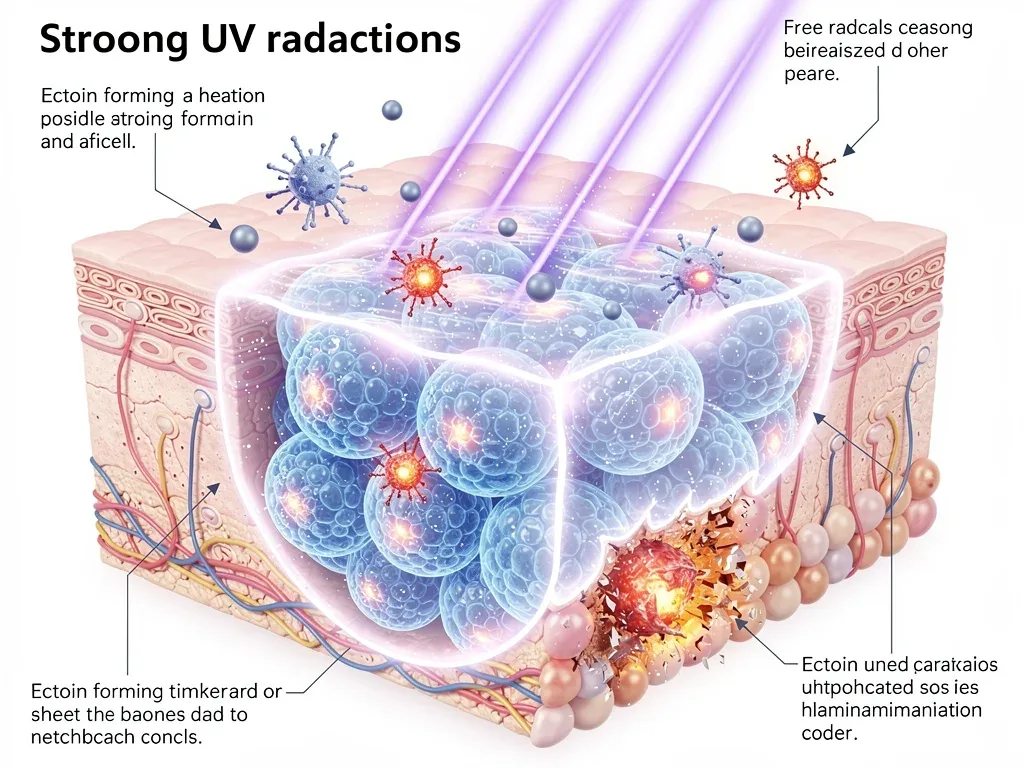
Ultraviolet radiation can trigger direct and indirect biological damage in skin, contributing to sunburn, photoaging and increased risk of skin cancer over time.
UVA and UVB interact differently with skin, while oxidative pathways can generate reactive oxygen species that affect proteins, lipids and cellular components.
This is why comprehensive sun protection focuses primarily on reducing UV exposure rather than attempting to repair oxidative consequences after exposure occurs.
Oxidative Stress Is Part of UV Damage
Reactive oxygen species generated after ultraviolet exposure can disturb normal cellular balance and participate in inflammatory and oxidative processes within the skin.
These processes can affect membranes, antioxidant systems, DNA-related pathways and structural components involved in maintaining healthy skin function.
Topical antioxidants and protective ingredients are therefore being researched as complementary strategies alongside established approaches that reduce ultraviolet exposure itself.
Lipid Oxidation Is One Possible Consequence
Skin contains multiple lipid structures that contribute to barrier function and include molecules that may undergo oxidation when exposed to environmental stress.
Research has examined biomarkers such as squalene oxidation as one way of investigating oxidative effects of ultraviolet radiation on the skin surface.
However, measuring one oxidative biomarker does not automatically prove that a topical ingredient prevents all forms of UV-induced lipid peroxidation in daily life.
Does 2% Ectoin Prevent UV-Induced Lipid Peroxidation?
The strongest available evidence does not support presenting 2% ectoin as clinically proven to prevent UV-induced lipid peroxidation through a seven-day topical routine.
The human study specifically using 2% ectoin focused on hydration and skin-aging parameters rather than measuring a defined pre-exposure photoprotection protocol.
Research involving UV exposure exists, but formulations, concentrations, co-ingredients and endpoints differ from the exact claim made in the original article.
Evidence Should Not Be Extended Beyond the Study
When a study evaluates a combination product, its results cannot automatically be attributed entirely to one ingredient contained within that formulation.
Likewise, laboratory protection against oxidative biomarkers does not necessarily translate into a clinically established reduction in sunburn or long-term photodamage.
Accurate skincare guidance should separate promising mechanistic evidence from outcomes that have actually been demonstrated in controlled human studies.
The Seven-Day Claim Is Not Established
No strong clinical evidence establishes seven days as the required preparation period for topical ectoin before a vacation, beach trip or other sun exposure.
There is also insufficient evidence to state that ectoin progressively accumulates in skin during those seven days to create a protective cellular shield.
Consumers can use ectoin according to a product's directions without treating one week of pre-exposure application as a medically validated requirement.
What Research Does Support About Ectoin
Human and experimental research supports continued interest in ectoin as a skin-conditioning ingredient with moisturizing and protective biological properties.
A controlled clinical trial using 2% ectoin reported benefits in hydration-related and skin-aging measurements without adverse effects among the participants studied.
Other studies have explored ectoin-containing formulations in ultraviolet-related models, though those formulations often include additional active ingredients or UV filters.
Hydration Is One of the Better-Supported Uses
Ectoin's relationship with water and biological structures provides a plausible basis for its use in products designed to support skin hydration.
The 2% clinical study found favorable moisturizing results, making hydration a more defensible consumer claim than guaranteed prevention of ultraviolet cellular damage.
Individual results can still vary according to formulation, climate, skin condition and the other ingredients included in the finished cosmetic product.
Barrier Support May Be Relevant
Hydrated skin and a functioning stratum corneum are important for maintaining the normal barrier that limits excessive water loss from the skin.
Ectoin-containing products may support that environment through moisturizing effects, though it should not be described as rebuilding every component of the barrier.
People with persistent barrier problems, severe irritation or inflammatory skin disease should seek individualized guidance rather than relying on one cosmetic ingredient.
Ectoin Has Been Studied Alongside UV Filters
One clinical investigation evaluated a very high broad-spectrum sunscreen containing UV filters and ectoin in people with polymorphic light eruption.
The product was tested against an untreated area during repeated UVA exposure and showed protective effects in that specific clinical setting.
Because the formulation contained a high-protection UV-filter system, the results cannot establish how much protection ectoin alone would have provided.
Combination Research Is Still Useful
Combination studies can help researchers determine whether supporting biological ingredients may have a place alongside conventional ultraviolet-filtering technologies.
They are particularly useful for examining biomarkers or skin responses that may persist even when an effective sunscreen absorbs much of the incoming radiation.
However, the practical conclusion is to use ectoin as a complement to validated sun protection rather than as an alternative to sunscreen.
Ectoin and Mannitol Have Also Been Investigated
Another study evaluated an association of ectoin and mannitol together with SPF 30 UV filters in experimental and small human assessments.
The combination provided greater preservation of selected biomarkers, including squalene oxidation and catalase activity, than UV filters alone in that study.
Because ectoin and mannitol were used together, the results cannot prove that 2% ectoin alone would reproduce the same measured effects.
Ectoin Is Not a Sunscreen Filter
Ectoin should not be marketed or interpreted as though it absorbs sufficient UVA and UVB radiation to replace an approved sunscreen product.
Sunscreens are specifically formulated and tested to demonstrate labeled ultraviolet protection under standardized conditions before making regulated SPF claims.
Ectoin belongs in the supportive-skincare category unless the finished product itself has undergone the testing required to carry sunscreen claims.
SPF Measures a Different Function
SPF primarily expresses a sunscreen product's protection against sunburn-producing ultraviolet radiation under standardized test conditions rather than cellular antioxidant activity.
A serum that reduces an oxidative biomarker cannot therefore be assigned an SPF or treated as providing equivalent UV protection without appropriate testing.
This distinction helps prevent supportive skincare ingredients from creating a false sense of security during prolonged outdoor exposure.
Ectoin Cannot Make Sunscreen Optional
Using ectoin in the morning does not remove the need for appropriate sunscreen when ultraviolet exposure warrants protection.
Likewise, applying an ectoin product for several days before a vacation does not create reserve protection that permits longer unprotected sun exposure.
Sun-protection behavior should remain based on actual UV exposure and established protective measures rather than prior cosmetic preparation.
How to Build a Sensible Ectoin Skincare Routine
Consumers interested in ectoin can generally incorporate a compatible serum, moisturizer or other leave-on product into an existing skincare routine.
The ideal position depends on the product's texture and formulation rather than an absolute scientific requirement that ectoin always appear at one specific step.
Following the manufacturer's directions is more useful than forcing every ectoin product into a rigid multi-step routine designed for another formulation.
Morning Routine
A simple morning routine can begin with cleansing when needed, followed by an ectoin-containing product and moisturizer if additional hydration is desired.
Sunscreen should remain the final dedicated sun-protection step before makeup or other products that the manufacturer recommends applying afterward.
There is no evidence that a toner is mandatory before ectoin or that skin must be manually returned to a specific pH for the ingredient to work.
Evening Routine
Ectoin can also be used in an evening routine when the selected product is intended for regular daily application and feels comfortable on the skin.
Nighttime use may support hydration, but it should not be presented as accumulating ultraviolet protection for the following day without supporting evidence.
Keeping the routine simple may be preferable for sensitive skin because adding several new active products simultaneously makes irritation harder to identify.
Should Ectoin Be Applied Twice a Day?
The appropriate frequency depends on the formulation and its instructions, and there is no universal medical requirement to apply every ectoin product twice daily.
Some products are designed for morning and evening use, while others may be intended once daily or incorporated into another treatment format.
More frequent application should not automatically be assumed to provide proportionally greater protection against UV exposure or oxidative stress.
Consistency Matters More Than an Invented Schedule
For hydration-focused skincare, regular use according to directions is generally more meaningful than trying to follow an unsupported seven-day loading period.
A person who enjoys the product may continue it as part of daily skincare instead of reserving ectoin exclusively for the week before sun exposure.
If irritation develops, reducing frequency or discontinuing the product may be more appropriate than persisting simply to complete a predetermined routine.
Can Ectoin Be Combined With Vitamin C?
Ectoin and vitamin C may appear in the same skincare routine because they work through different mechanisms and are used for different cosmetic goals.
However, there is no need to add vitamin C solely because an ectoin routine has reached a particular day or phase.
The tolerability of the finished formulations matters more than the theoretical compatibility of individual ingredients considered in isolation.
Introduce Active Products Carefully
People prone to irritation may prefer introducing one new product at a time so they can identify the cause if redness or discomfort develops.
Vitamin C formulas also differ substantially in acidity, concentration and derivative, meaning tolerance cannot be predicted from the ingredient name alone.
A routine intended to support sun-exposed skin should not become so aggressive that it creates irritation or disrupts normal barrier comfort.
Antioxidants Complement but Do Not Replace Sunscreen
Topical antioxidant ingredients are studied because ultraviolet exposure can generate reactive species even when people use ordinary sun-protection measures.
That makes antioxidant skincare an interesting complementary category, but it does not confer permission to deliberately increase UV exposure.
Products should therefore be described as supportive additions rather than shields capable of compensating for inadequate sunscreen application.
More Ingredients Do Not Always Mean Better Protection
Layering several antioxidants may sound comprehensive, but combining multiple products can increase cost, complexity and irritation without guaranteeing additional clinical benefit.
The final formulation, ingredient stability and concentrations all influence performance more than simply counting the number of antioxidant names on labels.
A well-tolerated routine containing sunscreen and basic moisturization can be more practical than an elaborate regimen built around theoretical ingredient synergies.
FDA Guidance Remains the Foundation of Sun Protection
For consumers in the United States, sunscreen products are regulated differently from ordinary cosmetic serums because they make drug-related sun-protection claims.
The FDA recommends regular use of broad-spectrum sunscreen together with additional measures such as protective clothing, sunglasses and limiting intense sun exposure.
No ectoin-containing cosmetic should be used to override the directions on an approved sunscreen label or to extend the labeled protection interval.
Apply Sunscreen Before Sun Exposure
FDA directions advise applying sunscreen liberally to exposed skin about 15 minutes before going outdoors so the product can provide its intended benefit.
People should use enough product to cover exposed areas rather than relying on a very thin cosmetic-style layer intended primarily for facial skincare.
For full-body exposure, the required quantity is substantially greater than the small amount typically used for a serum or moisturizer.
Reapply at Least Every Two Hours
The FDA advises reapplying sunscreen at least every two hours during outdoor exposure and more often when swimming or sweating.
Water-resistant products specify whether their tested protection lasts 40 or 80 minutes while swimming or sweating before reapplication is required.
Towel drying can also remove sunscreen, making label-directed reapplication important even when another protective skincare ingredient is already present.
Broad-Spectrum Protection Matters
A sunscreen labeled broad spectrum has met testing requirements related to protection across both UVA and UVB portions of ultraviolet radiation.
This matters because focusing only on sunburn can overlook longer-wavelength UVA exposure involved in photoaging and other skin effects.
Ectoin research does not change the importance of selecting properly tested broad-spectrum protection when meaningful sunlight exposure is expected.
SPF Should Not Be Used as a Timer
The FDA emphasizes that SPF does not tell consumers how many hours they can safely remain in sunlight before needing another application.
Actual ultraviolet exposure depends on factors including time of day, location, weather, activity and how much sunscreen remains on the skin.
This is another reason why adding ectoin cannot be translated into extra minutes or hours of supposedly safe unprotected sun exposure.
Does Ectoin Help Sensitive Skin?
Ectoin's moisturizing and generally well-tolerated profile makes it an ingredient of interest for products intended for dry or sensitive-feeling skin.
The 2% clinical trial reported no adverse effects among its study participants, though that does not guarantee every formulation will suit every person.
Fragrance, preservatives, solvents and other ingredients in the finished product can influence tolerance independently of ectoin itself.
Patch Testing Can Be Practical
People with reactive skin may consider trying a new cosmetic product on a small area before applying it broadly across the face.
This cannot predict every allergic or irritant reaction, but it can sometimes identify immediate incompatibility before more extensive application.
Persistent burning, swelling, blistering or worsening dermatitis warrants stopping the product and seeking professional assessment when appropriate.
Ectoin and Skin Hydration
Among ectoin's cosmetic applications, hydration has clearer human evidence than many of the stronger sun-defense claims often used in marketing.
The 2% clinical trial assessed moisturizing properties alongside skin-surface and elasticity measurements and found favorable results for the ectoin formulation.
This makes moisture support a realistic reason to consider ectoin even for consumers who are not seeking a specialized environmental-defense routine.
Hydrated Skin Is Not UV-Proof Skin
Improved hydration can make skin feel smoother and support normal barrier comfort, but it does not prevent ultraviolet radiation from reaching living tissue.
A well-moisturized person can still sunburn and accumulate UV damage if appropriate sun-protection measures are not used.
Keeping these functions separate prevents hydration benefits from being unintentionally marketed as equivalent to proven photoprotection.
Ectoin and Environmental Stress
Laboratory and cosmetic research has explored ectoin in the context of environmental stressors beyond ultraviolet radiation, including dehydration and oxidative challenges.
These findings help explain why the ingredient appears frequently in products marketed around urban exposure, barrier support or environmental defense.
However, broad claims such as complete protection from pollution or blue light require formulation-specific evidence rather than assumptions based on one mechanism.
Blue-Light Claims Require Caution
Blue-light skincare has become a common marketing category, but biological relevance depends on wavelength, exposure dose and the conditions used in each study.
Everyday exposure from phones and computer screens should not automatically be equated with experimental high-intensity visible-light conditions.
Ectoin should therefore not be described as necessary protection against routine screen use without direct evidence supporting that practical claim.
Why Product Formulation Matters
Two products containing the same percentage of ectoin can perform differently because delivery systems, supporting ingredients and overall formulation influence skin behavior.
Stability, texture, preservatives and other components also determine whether a product remains comfortable and practical enough for consistent use.
Consumers should therefore avoid choosing solely by the largest ectoin percentage when comparative clinical evidence between products is unavailable.
Higher Percentage Is Not Automatically Better
Cosmetic ingredients often have useful concentration ranges rather than a simple relationship where doubling the percentage doubles the clinical benefit.
A higher concentration may change texture, tolerability or cost without providing a proportionate improvement in the outcome a consumer actually wants.
The finished product's evidence and instructions are therefore more meaningful than interpreting 2%, 5% or 7% as universal rankings of effectiveness.
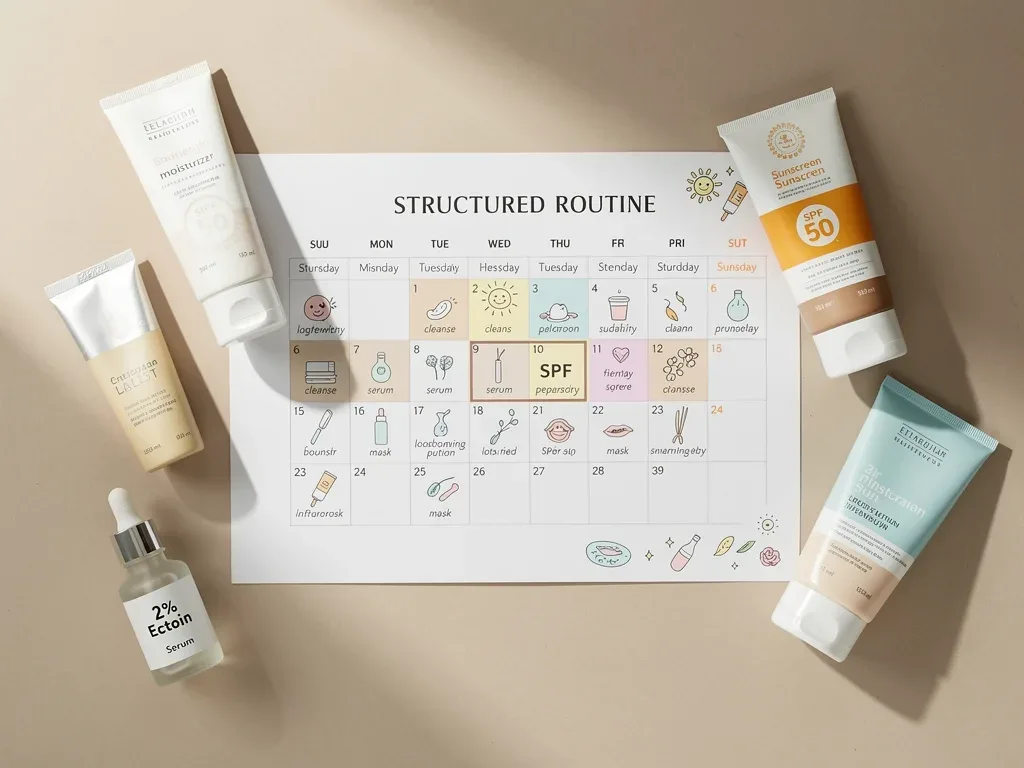
A Practical Ectoin Sun-Support Routine
A realistic routine can use ectoin as a hydration-focused supportive step while keeping validated sunscreen and physical protection as the primary UV defenses.
There is no requirement to begin exactly seven days before an outdoor event, and regular use can continue whenever the product suits the skin.
The goal should be a tolerable routine that encourages consistent sun protection rather than creating a false impression of preconditioning the skin.
Morning Example
Cleanse or rinse according to skin needs, then apply the ectoin-containing product according to its label and follow with moisturizer when required.
Apply a suitable broad-spectrum sunscreen afterward and use additional protection such as shade, sunglasses, hats or clothing when exposure is substantial.
Reapply sunscreen according to its directions rather than relying on the earlier ectoin layer to maintain ultraviolet protection throughout the day.
Evening Example
Remove sunscreen, makeup and daily residue using a cleansing approach that does not leave the skin persistently tight, burning or uncomfortable.
An ectoin moisturizer or serum can then be used according to product directions, followed by another moisturizer if the formulation does not provide enough hydration.
No special evening application is required to create a reserve of sunscreen-like protection for the following day's ultraviolet exposure.
What to Do Before a Beach Trip
The week before a high-exposure trip is better used to establish a comfortable routine than to attempt an unproven seven-day ectoin loading protocol.
Avoid introducing several irritating treatments immediately before travel if previous experience suggests they make the skin sensitive, dry or inflamed.
Most importantly, plan actual sun protection by bringing enough sunscreen, protective clothing, sunglasses and options for shade during prolonged outdoor periods.
Ectoin Can Remain Part of That Routine
If an ectoin product already works well, there is no obvious need to stop it before increased outdoor exposure.
Its hydrating properties may be useful when travel, heat, air conditioning or repeated cleansing makes skin feel drier than usual.
The benefit should still be described as supportive skincare rather than pre-sun immunization against ultraviolet damage.
Common Ectoin Claims That Need Context
Skincare marketing often converts early laboratory findings into stronger consumer claims than the underlying evidence can comfortably support.
Ectoin illustrates this problem because there is legitimate science behind the molecule but not every viral routine derived from that science has been clinically tested.
Distinguishing established results from plausible mechanisms makes the ingredient more credible rather than diminishing its potential value.
“Creates a Protective Cellular Shield”
This phrase simplifies ectoin's interactions with hydration and biological structures into language that can sound like a physical UV barrier.
It is more accurate to say ectoin has demonstrated cell-protective and stabilizing properties under certain experimental conditions.
Those properties do not create an invisible sunscreen layer capable of replacing UV filters or blocking a known percentage of radiation.
“Builds Up in the Skin for Seven Days”
The available evidence does not establish a consumer protocol in which seven consecutive days of 2% topical ectoin produce a clinically defined reservoir.
That claim should therefore not be used to predict stronger protection on day seven than on earlier days without formulation-specific research.
Regular application may still be appropriate for skincare benefits, but the rationale should remain consistent with the actual evidence.
“Enhances Sunscreen Efficacy”
Research combining ectoin-related active systems with UV filters suggests complementary biological protection may be possible in specific tested formulations.
That does not prove that placing an arbitrary ectoin serum underneath any sunscreen increases the labeled SPF or UVA protection.
Only testing of the complete sunscreen formulation can establish the protection represented by its regulated label claims.
Who Should Be Cautious With New Skincare Products?
People with active dermatitis, severe rosacea, recent procedures or known contact allergies may react to ingredients other than ectoin in a finished formulation.
Those using prescription dermatologic treatments should also consider whether a new routine could increase irritation or interfere with instructions already provided.
When skin disease is significant, personalized advice from a qualified clinician is more appropriate than relying on a generalized cosmetic protocol.
Sun Sensitivity Can Have Medical Causes
Some medications and health conditions increase photosensitivity, making ordinary cosmetic routines inadequate for managing individual UV risk.
People who develop unusual rashes, blistering or severe reactions after relatively modest sun exposure should seek medical evaluation instead of self-treating.
Ectoin should not be presented as a treatment for photodermatoses simply because it appears in research involving ultraviolet-related skin responses.
What Current Evidence Supports
Ectoin has credible research supporting its use as a topical skincare ingredient, particularly for hydration and protection of biological structures under stress.
Studies involving ultraviolet exposure suggest potential complementary photoprotective roles, especially when ectoin is used within more complex tested formulations.
The evidence does not establish 2% ectoin applied for seven days as a stand-alone protocol proven to prevent UV-induced lipid peroxidation in consumers.
The Most Accurate Takeaway
Ectoin is a promising supportive ingredient rather than a replacement for broad-spectrum sunscreen or other established measures that reduce ultraviolet exposure.
A 2% product can be reasonable for routine skincare based on existing human evidence, but its benefits should not be exaggerated into guaranteed sun protection.
Consumers benefit most when ingredient science is combined with realistic expectations and consistent use of validated photoprotection.
Claim | What the Evidence Supports |
|---|---|
2% Ectoin | Human research supports moisturizing and skin-conditioning benefits. |
7-Day Pre-Sun Protocol | No established clinical evidence confirms this exact preparation period. |
UV Support | Experimental and combination-product studies suggest complementary protective potential. |
Lipid Oxidation | Some combination research measured protection of oxidative biomarkers such as squalene. |
Sunscreen Replacement | Ectoin does not replace tested broad-spectrum sunscreen. |
Frequently Asked Questions About Ectoin Sun Defense
Is 2% ectoin clinically studied?
Yes. A controlled human trial evaluated a 2% ectoin formulation and reported moisturizing and skin-aging-related benefits, but it did not validate a seven-day sun-preparation protocol.
Does ectoin prevent UV-induced lipid peroxidation?
Research suggests protective effects against oxidative stress, but evidence does not establish that 2% ectoin alone reliably prevents UV-induced lipid peroxidation in everyday consumers.
Should I use ectoin for seven days before sun exposure?
There is no established requirement to begin exactly seven days beforehand. Use an ectoin product according to its instructions if it suits your routine.
Can ectoin replace sunscreen?
No. Ectoin is not a substitute for properly tested broad-spectrum sunscreen and should be considered supportive skincare rather than primary UV protection.
Can ectoin increase my sunscreen's SPF?
You should not assume so. Only standardized testing of the complete sunscreen formulation can establish its labeled SPF and broad-spectrum protection.
Can I combine ectoin with vitamin C?
They can appear within the same routine, but tolerability depends on the specific formulations and there is no requirement to combine them for effective ectoin use.
Is ectoin useful for dry skin?
Hydration is one of the better-supported applications of topical ectoin, including evidence from a human study evaluating a formulation containing 2% ectoin.
How often should sunscreen be reapplied?
FDA guidance recommends reapplication at least every two hours outdoors and more frequently according to the label when swimming, sweating or towel drying.
Conclusion
An Ectoin Sun Defense Routine can reasonably include ectoin as a hydrating and supportive ingredient, but current evidence does not validate a mandatory seven-day protocol.
Research supports ectoin's biological and moisturizing properties while suggesting complementary value in some UV-related formulations, without establishing sunscreen-equivalent protection.
Broad-spectrum sunscreen, appropriate reapplication, protective clothing and sensible exposure habits remain the evidence-based foundation for protecting skin from ultraviolet radiation.